


One of the most common questions we hear from growth-minded dentists is:
“Should I add on to my existing practice… or build a second location?”
If there were ever a can-of-worms question in dentistry, this is it.
So here’s the direct answer:
In most cases, one bigger practice is easier to run than two smaller ones.
That doesn’t mean it’s always the right move. But if all things are relatively equal, expanding a strong practice usually creates more leverage than duplicating operations for one simple reason:
It’s easier to lead one team in one place than to split your leadership across two.
The rest of this article will walk you through the few variables that actually matter, so you can choose the smartest path for your practice before the deposits are paid and the construction starts.
The Factors That Should Drive the Decision
Before you even think about square footage or floor plans, the question needs to start with the fundamentals:
1) How strong is your current location?
Demographics matter.
- Is the area still growing?
- Are families moving in?
- Are incomes stable or rising?
- Are you in the “right” part of town long-term?
If your current location is already positioned in a strong demographic pocket, expanding may make far more sense than duplicating your overhead elsewhere.
For more information on choosing the right location for your dental office, check out this article.
2) How strong is the practice as a whole?
If your practice still needs major renovation, system upgrades, or operational improvement to reach the level you want it to be…
Then opening a second location may simply multiply the problems.
A second location doesn’t fix weaknesses. It replicates them.
3) What’s the competitive ratio in your area?
How saturated is your market?
- What’s the ratio of dentists to patients in your area?
- Are you fighting for market share?
- Or are you in a market that still has room to grow?
In some areas, expanding your footprint in the same market is the smarter move.
In others, a second location in a more favorable market may be the better long-term play.
4) What’s the growth opportunity of the second location?
Not all markets are created equal.
The right second location should have:
- clear demand
- clear access
- clear growth potential
- and a realistic ability to attract and retain staff
If the second location doesn’t beat the growth potential of your current location, you may be trading focus for very little return.
5) How hard will the expansion actually be?
Some expansions are straightforward.
Others involve:
- zoning restrictions
- parking limitations
- major construction disruption
- compromised layouts
- limited treatment flow
Sometimes the decision is less about strategy and more about practicality.
This is the “degree of difficulty” factor.
And to be clear: many of these “degree of difficulty” problems are design problems. They become objections because doctors assume the space can’t work,or the patient experience will suffer… or the office will feel chaotic.
This is exactly where our design team comes in. With the right layout, circulation, and operational planning, many expansion “limitations” can be solved elegantly.
And there’s also a psychology layer here that often gets missed:
When a practice is designed to feel organized, spacious, and confident, patients pick up on it instantly. In social psychology, this aligns with the wisdom of crowds effect. People tend to gravitate toward what appears busy, established, and successful.
A bigger practice that feels calm and intentional doesn’t scare patients off. It signals: “This is the place people choose.”
6) Ownership vs leasing opportunities
Finally, there’s the real estate side.
- Can you own the expanded space?
- Can you own the second location?
- Does one option lock in a stronger long-term asset position?
This alone can sway the decision for many doctors, though it should not be the primary driver. Facility decisions should be made first on operations, growth, and sustainability… and then optimized for real estate where possible.
Why Doctors Choose Two Smaller Practices (Even When It’s Not Ideal)
Most doctors who already run a six-chair practice think like this:
“I already know how to run a six-chair practice.”
So the logic becomes:
“I’ll just open another six-chair practice.”
Because it feels safe. It feels repeatable. It feels understandable.
And that’s the real driver: familiarity.
For many doctors, the appeal of two smaller practices isn’t that it’s better, it’s that it feels less intimidating.
The Truth Most Doctors Don’t Want to Hear
If all things are relatively equal, it is invariably easier to run one bigger practice than it is to run two smaller practices.
And that surprises a lot of doctors.
Not because they think a big practice sounds bad, but but because they have a built-in bias that it will feel too big, too complex, too hard to control.
Quite honestly, most doctors don’t resist the bigger practice because they’ve analyzed it and rejected it…
They resist it because they don’t know how to do it yet.
So instead of learning how to lead one larger operation, they default to something they understand: replicating the smaller model.
But two practices doesn’t mean half the stress, it usually means double the leadership burden:
- two teams
- two cultures
- two sets of problems
- two schedules
- two managers (or worse, no real managers)
- and a doctor who’s never fully in one place
Expansion Isn’t the Problem, Inexperience Is
The challenge isn’t that a bigger practice is automatically a bigger headache.
The challenge is that the doctor hasn’t done it before.
So they assume it must be harder.
In reality:
- yes, there are new systems to learn
- yes, management structure changes
- yes, communication and flow must evolve
…but you also gain:
- better team efficiency
- better scheduling leverage
- stronger delegation
- better use of a single leadership structure
- and more consistent culture
And here’s the key point:
It’s easier to manage one operation than two separate ones.
The Real Bottleneck: Management, Not Chair Count
If you’re thinking:
“My current manager could never handle a 15-chair practice…”
That’s not a practice-size decision. That’s a management decision.
Because the solution isn’t automatically:
“Then I should just open a second six-chair office.”
The solution is: Fix the management structure.
If the manager you currently have isn’t equipped for growth, you have two options:
- Train and elevate them
- Upgrade the position
But don’t make a multi-million dollar facility decision because you’re trying to avoid a staffing decision.
So what’s the better move: one bigger practice or two locations?
In most cases, one bigger practice is easier to run than two smaller ones.
Yes, the decision is complicated... and it should be. But if you strip away the noise and ask the core operational question, the answer usually comes down to this:
It’s easier to lead one team in one place than to split your leadership across two.
And if growth is being limited by management, the fix is rarely “another location.”
It’s usually this:
Better structure. Better systems. Better leadership.
Whether you expand your current footprint or open a second location, one thing is non-negotiable:
Your practice has to be running as efficiently as possible first.
Because growth doesn’t fix inefficiency, it amplifies it. And the bigger you get, the more costly small breakdowns become (scheduling, handoffs, sterilization flow, room turnover, communication, etc.).
If you want a practical next step, download the free chapter from our book, “Your Blueprint for Maximizing Dental Office Productivity."
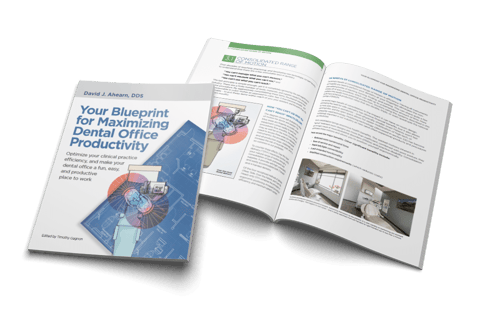
You’ll get proven strategies to increase productivity, tighten systems, and build the operational foundation you need before you invest in expansion or a second location.
Want help thinking through your expansion strategy?
If you’re weighing the decision between expanding your current footprint or building a second location, we can help you evaluate:
- space efficiency and flow
- chair count strategy
- staffing scalability
- operational leverage
- and the real-world ROI of each option
Schedule a free 30 min call with the experts on our team and let’s map out the smartest next step, before you commit to a plan that adds complexity without adding profit.
Topics: