The first step in creating a high-flow dental office.

Does your current office layout hinder patient care and efficiency? Imagine a dental office where operatories feel spacious and welcoming for both patients and your team. With a thoughtfully designed layout that minimizes bottlenecks and streamlines your workflow, you can enhance functionality and see the immediate impact of design changes on efficiency.
Have you received a floor plan from an equipment dealer or local architect?
We will review your floor plan with you and point out areas that:
Don't get stuck in a practice that limits your growth and hinders your productivity.
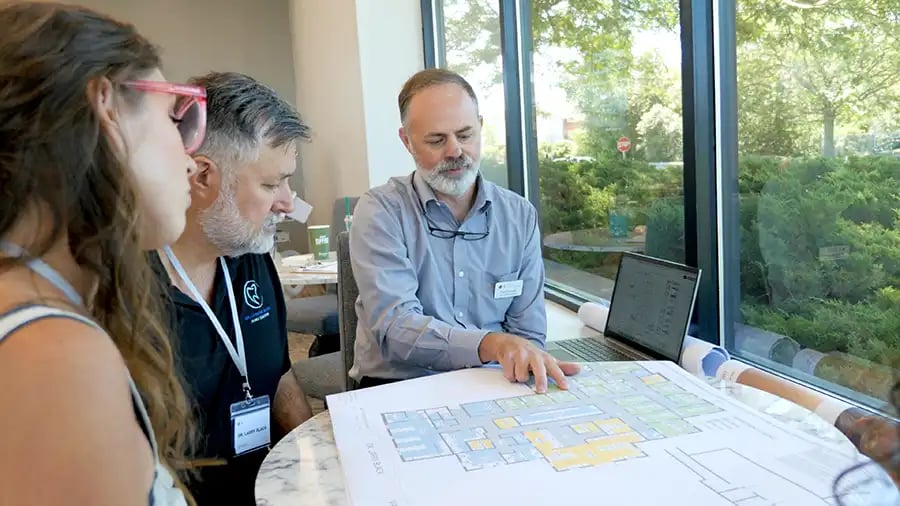
Don't get stuck in a practice that limits your growth and hinders your productivity. We design dental practices where every system works seamlessly to support your success. Ensure that your practice runs efficiently while providing comfort for your team and patients alike.
If you have any questions or would like to get started planning your new office, schedule a meeting with us, and we'll map out a clear path toward the practice you’ve always wanted.
CAD drawings of an existing space
$2,000*
“As-Built” CAD drawings are required to build accurate floor plans and often don’t exist for old or modified buildings.
We work directly with local specialists in your area to engineer precise plans of your space, saving you time and speeding you along on the journey to your dream dental office.
*Pricing starts at $2,000. Factors such as square footage and location may affect this.
Dental Practice Layout
$1,599
Blocking diagrams allow you to rapidly envision different office configurations. They are the best way to ensure that your chosen space is laid out in a way that supports your growth rather than limits it.
By placing treatment rooms, sterilization centers, and labs strategically, a practice can shorten walking distance, improve team communication, and reduce room turnaround time.
Your design team will work with you to find the perfect layout for your success.
Includes Blocking Diagram
$4,995
A dental office floor plan is the foundation of your operational success. It’s not just a drawing, it’s a strategy that determines how your team works, how your patients feel, and how your business grows.
Our designers take the time to meet with you and review each draft of your floor plan together to ensure that the design aligns with your vision. Dental-specific concerns such as acoustics, clinical flow, and case acceptance psychology are always accounted for.
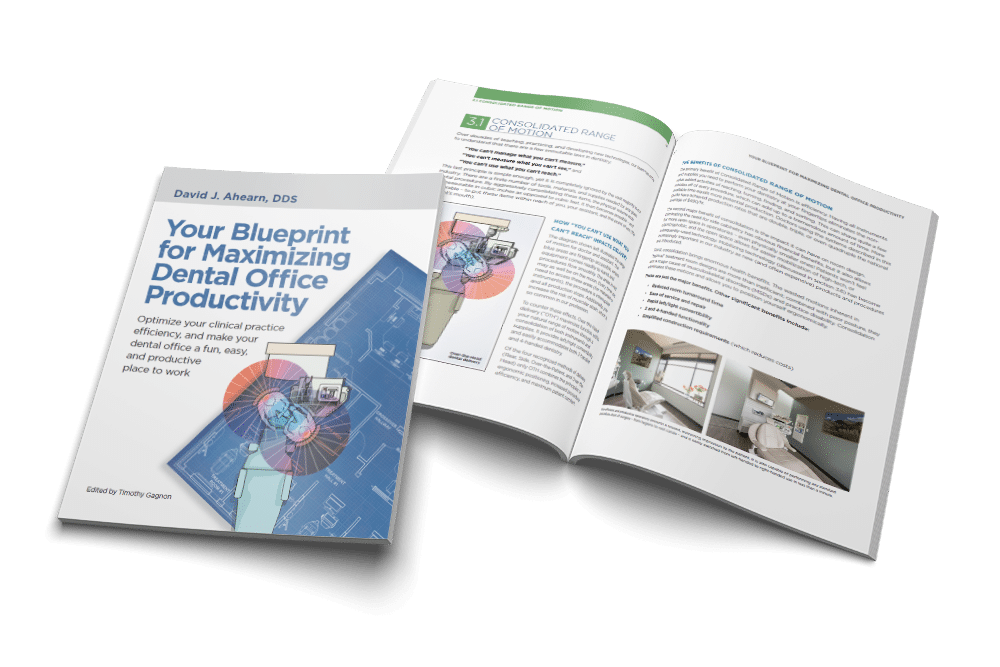
This FREE excerpt from Your Blueprint for Maximizing Dental Office Productivity covers office-centric design, sterilization, the psychology of spaciousness, and more!
— Dr. Colleen & Bill Bullard, Comprehensive Dentistry
Your most pressing questions about designing your dream dental practice, answered by our team of experts. Visit our design page for the entire design process.
You can expect initial dental office floor plans in under a week after we review your project details. Our team is structured for fast turnaround, so even complex designs move quickly and stay on schedule.
For more information, read our blog “How Long does it take to Build a Dental Office?”
A dental office design usually costs less than 1% of your total project budget. At Design Ergonomics, our Architectural Planning service starts at $4,995, which includes a detailed floor plan tailored to your vision. A strong design often saves you more in long-term efficiency and build costs. Our Architectural Planning service, which includes a detailed floor plan tailored to your vision, starts at $4,995.
Want to understand exactly what’s included and how it all breaks down? Explore our pricing page or watch this short video for a transparent overview of costs and value.
The first step is to schedule a free 30-minute discovery call with one of our practice advisors. In that call, we’ll review your goals, answer questions, and map out a clear path toward the practice you’ve always wanted.
Read our blog post “How Do I Even Get Started With My Dental Office Design?” to learn more.
An efficient dental office design minimizes wasted time, motion, and space while making it easier for the clinical team to deliver excellent patient care. The best dental office layouts improve workflow, reduce unnecessary walking, and create treatment rooms that support productivity without sacrificing patient comfort.
Efficiency starts with designing the office around how dentistry is actually practiced, rather than simply fitting rooms into available square footage. Every step a doctor, assistant, hygienist, and patient takes should be intentional. Treatment rooms, sterilization, laboratory space, supplies, and support areas should be positioned to reduce travel distances and eliminate bottlenecks. Efficient operatories also place instruments and supplies within easy reach, reducing repetitive motion and allowing the clinical team to focus on the patient instead of searching for materials.
The best dental office layout supports efficient clinical workflow, minimizes unnecessary movement, and enables the practice to grow over time. A successful layout carefully organizes operatories, sterilization, laboratory areas, business functions, and patient spaces so that every area works together. Our team has spent decades refining what makes a truly productive dental office. Explore our 18 Elements of an Ideal Dental Office Floor Plan to learn the design principles that help practices perform at their highest level.
The right number of operatories depends on your practice goals, patient demand, staffing, and long-term growth plans. Instead of asking how many treatment rooms you need today, it's often more valuable to design a practice that can accommodate where you want to be several years from now.
Planning for additional operatories during the initial design phase is far less expensive than renovating or relocating later. This approach provides flexibility without requiring the practice to immediately invest in fully equipping every operatory.
The best way to design a dental office for future growth is to plan for tomorrow's practice rather than today's patient volume. Many practices outgrow their facilities sooner than expected because they were designed around immediate needs instead of long-term goals. Choosing a location with room to expand, designing efficient workflows, and avoiding layouts that limit future modifications can help prevent costly renovations or relocations a few years later. Even if additional treatment rooms are not built immediately, planning for them during the design process preserves flexibility and reduces future disruption.
Improving workflow in a dental office starts with reducing unnecessary movement, eliminating bottlenecks, and designing the practice around how the clinical team actually works. Treatment rooms, sterilization, supply storage, laboratory space, and business areas should be organized so that people and materials move naturally through the office with minimal interruption. Small design decisions—such as where instruments are stored, how operatories are arranged, or how easily assistants can access supplies significantly impact productivity throughout the day.
The ideal number of hygiene operatories depends on your practice model. Your patient volume, scheduling model, and long-term growth plans are the core determinations regarding how many you’ll need, but that may be different from how many you should want. Rather than following a standard formula, hygiene capacity should be planned as part of the overall clinical workflow so preventive care, restorative treatment, and patient flow remain balanced.
As the practice grows, hygiene often becomes one of the first areas to experience scheduling pressure. Your patients will not refer others to a practice that they themselves cannot get back into for a "cleaning" for a month or two. Planning sufficient hygiene capacity during the design phase helps reduce appointment delays, improves patient access, and creates flexibility as demand increases. It also ensures that sterilization, supply storage, and support areas can accommodate increased clinical activity.
In many cases, you can add more operatories without dramatically increasing your building's size by improving space efficiency rather than simply expanding the footprint. Better space planning can reduce wasted hallways, oversized rooms, and unnecessary support space, allowing more treatment capacity within the same overall square footage.
A lot less than they may have told you.
A dental office should typically plan for about 330–350 square feet per operatory when the entire practice is designed efficiently. Traditional dental offices often require 450–550 square feet per operatory, largely because of oversized rooms, excess circulation space, and inefficient support areas.
The better measurement is room yield: the total square footage of the practice divided by the number of operatories it supports.
For example, a well-designed 10-operatory dental practice may require approximately 3,300–3,500 square feet rather than 4,500–5,500 square feet.
Less square footage does not mean a cramped office. Efficient layouts eliminate wasted space while giving the clinical team the room, equipment, storage, and support systems they need to work productively.
Plan for approximately 330–350 square feet of total office space per operatory, including the treatment rooms, sterilization, business areas, support spaces, and circulation.
This is different from the physical size of the treatment room itself. The goal is not to make each operatory as large as possible. It is to place equipment, instruments, and supplies within the clinical team's natural working range.
Efficient operatories reduce unnecessary movement, eliminate bulky cabinetry, improve ergonomics, and allow a practice to support more treatment rooms within the same overall footprint.
A well-designed dental office should typically provide approximately 330–350 square feet of total office space per operatory.
That means a 10-operatory practice may require approximately 3,300–3,500 square feet when designed efficiently.
Traditional dental office layouts often require 400–500+ square feet per operatory because more space is consumed by oversized rooms, inefficient circulation, costly and unnecessary cabinetry, and poorly planned support areas.
The better question isn't, “How many square feet should my dental office be?”
It's “How many operatories does my practice need to support its long-term goals?”
Schedule a meeting with one of our expert Practice Advisors to discuss your design goals.